


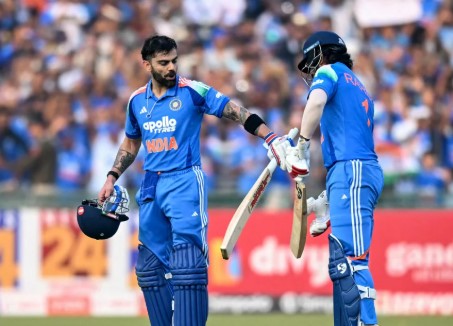
After a narrow 17-run defeat in the first ODI, South Africa made the best use of damp conditions in the second ODI against India, winning the match by 4 wickets despite chasing a target of 359 runs.
A total of 358 runs on the board, yet the KL Rahul-led Indian team had to taste defeat. South Africa arrived at the Shaheed Veer Narayan Singh International Stadium in Raipur after facing a narrow loss against India in the ODI series opener, determined to make amends for their mistakes. The morale of any other opponent team would have been broken seeing majestic centuries from Virat Kohli and Ruturaj Gaikwad, but for South Africa, the game was only half done at the innings break. South Africa delivered a record-equalling chase to win the second One-Day International by four wickets, leaving India and captain KL Rahul to lament a perfect storm of unfavourable conditions and costly errors.
But what was the reason behind India's failure to defend 358, a tragically insufficient total? Arguably, the biggest factor was the relentless and heavy dew factor that blanketed the stadium throughout South Africa's evening chase.
Dew: The Biggest Villain
This wasn't just dampness; it was a swamp that rendered India's otherwise world-class bowling attack almost helpless. The dew at the venue made gripping the ball incredibly difficult for all the Indian bowlers. Asked if the defeat was a bitter pill to swallow, India captain KL Rahul said, "Not really, considering how much dew there is and how difficult it is to bowl in the second innings. The umpires have been nice enough to change the ball a few times, but still the toss plays a huge part. I'm kicking myself about losing two tosses in a row. There are always things that we could have done better. I know that 350 looks good, but that's also been the chat in the dressing room even after the last game - how can we get that extra 20-25 so that the bowlers find some cushion when they bowl with the wet ball."
The ball, quickly saturated with moisture, lost its ability to swing, seam, or grip the pitch for spin. Delivery after delivery, the ball skidded onto the bat, sometimes even becoming a 'bar of soap' in the hands of the bowlers, and simultaneously turning batting into a relative cakewalk.
South African batsmen, particularly centurion Aiden Markram, capitalised ruthlessly on the lack of control, driving and cutting with ease as the ball flew off the bat. The umpires were even forced to change the ball in an attempt to restore parity, but the dew's impact remained terminal.
The Toss Curse: A One-in-a-Million Probability
The conditions made the pre-game flip of the coin a high-stakes event, and Indian captain Rahul was left "kicking himself" after losing his 20th consecutive ODI toss. This staggering run of bad luck has a probability of just over one-in-a-million (or 0.000095), a statistical anomaly that could not have come at a worse time.
South Africa's captain, Temba Bavuma, had no hesitation in choosing to bowl first, well aware that the dew would gift his batsmen the advantage in the second innings. Losing the toss meant India had to bat first, sending them on a journey that didn't just require the likes of Kohli, Ruturaj, Rahul, etc. to outplay the opponent team's bowlers but also register a score enough to minimise 'nature's play' at the venue.
Costly Fielding Errors
While the dew was the main antagonist, India's performance was undermined by other critical factors. Despite the efforts of players, who often struggled to cope with the slippery conditions, India's fielding was below par. Dropped catches and misfields proved expensive, giving reprieves to set batsmen like Aiden Markram, who went on to score a magnificent century. Rahul himself stressed that the team "needed to be sharper." However, the dew also played a significant role in making fielding difficult.
In the end, even 358 runs, a score that wins most matches, was not enough to overcome the challenge posed by dew. If India's bad luck at winning tosses continues in the third and final match of the series, expect the home team to target nothing less than a score of 380 if they are asked to bat first.


comments


Other categories
Recent Comments