


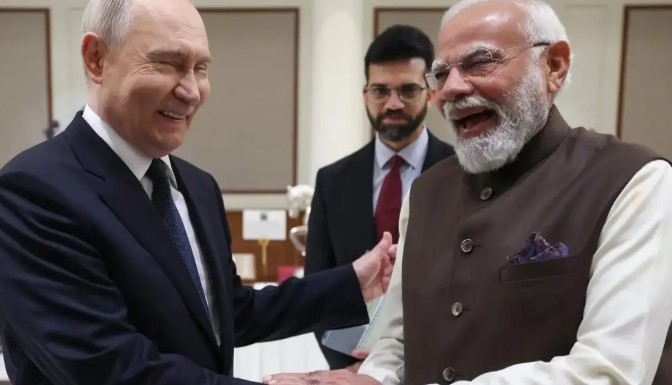
Putin urges caution on de-dollarisation, citing Europe’s euro experience, and stresses Rupee–Rouble trade hurdles are economic, not political, with solutions focused on expanding bilateral business opportunities.
Russian President Vladimir Putin, while addressing the buzz around de-dollarisation and looking for an alternative payment system suggested that there should be "no haste", citing the Europe's example with the euro. In an interview with India Today, Putin said such idea is necessary but should only be executed carefully when the system aligns properly and makes economic sense.
“There is no need for haste. And if there is no hurry, then you will avoid many grave mistakes,” he said. He pointed to the eurozone as an example, noting how countries that weren’t ready for a single currency were brought in, only to face social and financial imbalances later. “You know, you cannot simply enforce a common system when the underlying structures are not aligned,” he added.
When he was asked what was stopping Rupee-Rouble trade despite mutual support and cooperation, Putin said it had nothing to do with politics but purely an economics decision.
Why Can The US Buy Russian Fuel But Not India? Putin Slams Trump’s Tariffs
Explaining his point further, Putin highlighted the trade imbalance between the two countries which makes the settlement in Rupees not feasible. Russia, with its oil sales, can earn far more rupees than it could probably spend in India, he elaborated.
There is no obstacle here. This is a matter of economy,” Putin said, explaining that India’s demand for Russian oil, petroleum products, and fertilisers naturally boosts Russia’s earnings in rupees. He clarified that the issue isn’t about accepting rupees but about what Russian companies can purchase in India with the rupees they accumulate. “Please, it is not about rupees or payments, but what could be bought with these rupees by our companies, and we are thinking about it,” he said.
Putin Pushes Trade Solutions, Not Restrictions, to Address India-Russia Imbalance
Putin clarified that India has not imposed any restrictions on bilateral trade. On the contrary, he noted that Prime Minister Narendra Modi has been urging Russia to increase fertiliser supplies to support Indian farmers. “The Indian government requires wider purchase of Russian fertilisers because these fertilisers are urgently needed for the agrarian sector in India,” he said.
To tackle the trade imbalance, Putin said Russia is taking proactive steps. During his visit, Moscow will host a special meeting of Russian importers to identify Indian products and sectors from which Russia can scale up purchases.
He added that the initiative came directly from him as a directive to the Russian government. “At our initiative, during my visit, we are going to hold a special meeting of Russian importers from India. This was a direct decree by me to the Russian government to think through what could be additionally done in terms of purchasing from India,” he said.
Putin emphasised that both sides agree the imbalance must be corrected but insisted it should be done by expanding business opportunities rather than restricting trade flows. “This disparity should be amended but not through bans. It should be through the search for such spheres of business activity that would benefit both us and India,” he said.
Regarding the global discussion around a BRICS currency, Putin cautioned against rushing toward a new monetary structure. He believes the transition away from dollar dominance should be gradual and driven by real economic needs, not political enthusiasm. Local currency trade, such as rupee–rouble settlement, will expand steadily as trade patterns evolve.


comments


Other categories
Recent Comments