


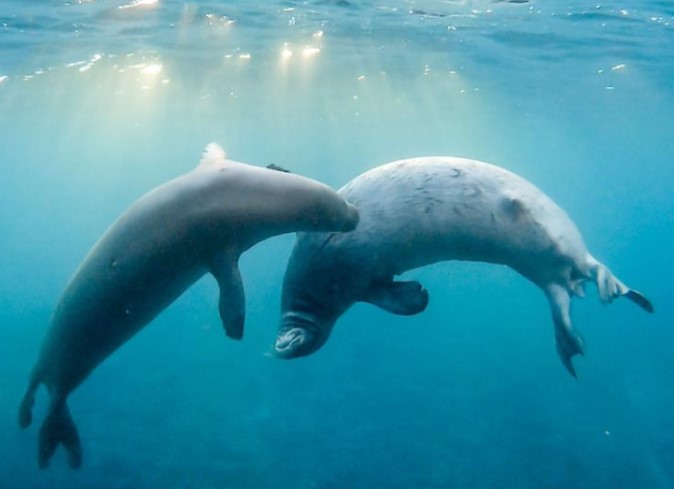
Researchers discovered that Hawaiian monk seals use a surprisingly complex range of underwater sounds, including new call types never documented before.
The findings could transform how scientists monitor and protect this endangered species in an increasingly noisy ocean.
A New Window Into Monk Seal Underwater Communication
A recent study led by the UH Hawaiʻi Institute of Marine Biology (HIMB) Marine Mammal Research Program (MMRP) is reshaping what scientists know about how Hawaiian monk seals (Neomonachus schauinslandi) communicate underwater. Published in Royal Society Open Science, the research draws on thousands of hours of passive acoustic recordings and documents 25 different underwater call types. This sharply expands the known vocal range of the species, which previously included only six calls identified from seals living in human care.
The researchers found that monk seals produce low-frequency sounds throughout the day. These vocalizations appeared consistently across the Hawaiian Archipelago, and calling activity was highest in locations where seal populations were larger. Together, these findings provide an essential reference point for studying the acoustic environment of one of Hawaiʻi’s most endangered and uniquely local species.
Uncovering a Hidden World of Sound
“We discovered that Hawaiian monk seals—one of the world’s most endangered marine mammals—are far more vocal underwater than previously known,” shares Kirby Parnell, lead author of the study and a PhD candidate with MMRP. “By analyzing over 4,500 hours of recordings from across the Hawaiian Archipelago, we identified more than 23,000 vocalizations representing at least 25 distinct call types.”
To reach these conclusions, the team deployed passive acoustic recorders at five important monk seal habitats, ranging from Molokaʻi to the remote Northwestern Hawaiian Islands. Their analysis revealed several major discoveries:
- Expanded Vocal Repertoire: The study documented 20 call types that had never been recorded before.
- Novel Communication Strategy: The data show that monk seals can link different sounds together to form “combinational calls”—a behavior that has not previously been reported in any pinniped species.
- A Foraging Call: Researchers identified a new elemental vocalization known as the Whine, produced while seals were foraging. This marks only the second known case of a seal species vocalizing during active prey pursuit.
“We were surprised by the sheer diversity and complexity of monk seal vocalizations,” notes Parnell. “The discovery of combinational calls, where seals link multiple call types together, suggests a previously unknown level of complexity in pinniped acoustic communication. Finding a new call type—the Whine—associated with foraging behavior was also unexpected and suggests that monk seals may use sound not only for mating or socializing, but possibly for foraging purposes as well.”
Why These Findings Matter for Conservation
The Hawaiian monk seal is the only marine mammal species found exclusively in Hawaiʻi and holds deep cultural significance. Understanding how these animals communicate is increasingly important as human activity raises background noise levels in the ocean.
“This research provides the first comprehensive description of free-ranging Hawaiian monk seal underwater sound production, an important step toward understanding how they use sound for critical life-history events,” explains Lars Bejder, Director of MMRP, Professor at HIMB, and co-author of the study. “Because their vocalizations overlap with the same low-frequency range as many human-generated sounds (e.g. vessel noise), this work also helps us evaluate how ocean noise may affect communication, reproduction, and behavior in this endangered species.”
The findings open the door to expanded use of passive acoustic monitoring as a way to track monk seal populations across their wide geographic range and safeguard the sound environments they depend on. Future studies aim to directly connect specific call types to behaviors such as swimming, foraging, social interaction, and reproduction. Another important goal is the development of automated detection tools that can monitor seal vocal activity efficiently and without disturbance, offering a long-term resource for conservation and ecosystem research.
The Collaborative Effort Behind the Study
The research team included graduate students, undergraduate students, and recent alumni from the University of Hawaiʻi at Mānoa, along with collaborators from France and the Pacific Islands Fisheries Science Center’s Hawaiian Monk Seal Research Program.
“Manually annotating over 23,000 calls by hand is no small feat, and I have a team of interns to thank for helping with the analysis!” shares Parnell. “This research would also not have been possible without the support of the Hawaiian Monk Seal Research Program, who deployed and retrieved the acoustic recorders in the Papahānaumokuākea National Marine Sanctuary.”


comments


Other categories
Recent Comments