


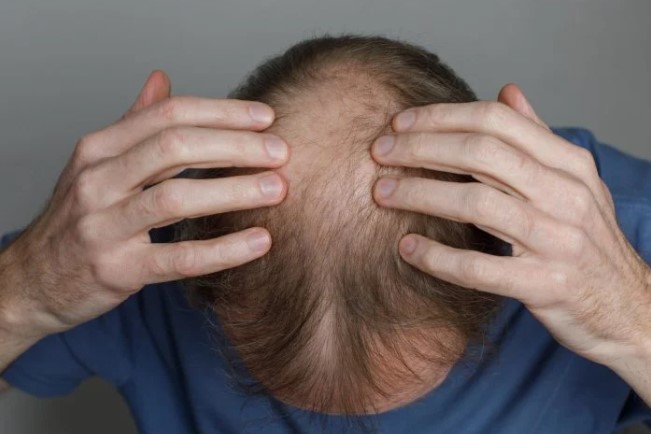
A centuries-old medicinal root is gaining renewed scientific attention for its ability to target multiple biological processes involved in hair loss.
Androgenetic alopecia (AGA) is the most common form of hair loss seen in medical practice, affecting millions of people worldwide. Although often associated with aging, it increasingly appears at younger ages and affects both men and women.
Typical signs include a receding hairline at the temples, thinning at the crown or forehead, and scalp symptoms such as oiliness, dandruff, itching, folliculitis, and acne. Without early treatment, progressive thinning can eventually lead to noticeable baldness.
Today, treatment options remain limited. Finasteride and minoxidil are the primary medications used to manage AGA. Minoxidil works by stimulating hair follicle cells after being converted into its active form in the scalp, while finasteride blocks the enzyme that converts testosterone into dihydrotestosterone (DHT), the hormone most strongly linked to follicle shrinkage.
Despite their effectiveness, both drugs are associated with side effects that many patients find concerning, including scalp irritation, hormonal effects, and anxiety about long-term use. As a result, there is growing interest in safer, multi-targeted alternatives.
An Ancient Remedy Revisited by Modern Science
A new scientific review published in the Journal of Holistic Integrative Pharmacy points to an unexpected candidate. Polygonum multiflorum, also known as Polygoni multiflori radix (PMT) or He Shou Wu, is a root used in traditional Chinese medicine for more than a thousand years. Ancient texts famously describe it as an herb that can “blacken hair and nourish essence.” Modern research now suggests those claims may have a biological basis.
“Our analysis bridges ancient wisdom and modern science,” said Bixian Han, the first author of the review. “What surprised us was how consistently historical texts from the Tang Dynasty onward described effects that align perfectly with today’s understanding of hair biology. Modern studies now confirm that this isn’t folklore; it’s pharmacology.”
Targeting Hormonal Pathways and Follicle Survival
Unlike conventional hair loss drugs that act on a single pathway, PMT appears to work on several fronts at once. Laboratory and animal studies show that extracts of the processed root strongly inhibit 5α reductase, the enzyme responsible for producing DHT. Certain compounds in PMT, including emodin and physcion, directly reduce DHT levels in skin tissue and suppress androgen activity linked to follicle miniaturization.The herb also protects hair follicle cells from premature death. AGA is associated with abnormal apoptosis, or programmed cell death, which shortens the hair growth phase and leads to thinner strands. Key PMT components, particularly 2,3,5,4′-tetrahydroxyl diphenylethylene-2-O-glucoside (TSG), activate survival pathways such as PI3K/Akt, increase protective proteins like Bcl-2, and suppress pro-apoptotic signals including Bax, Fas, and Caspase-3. These effects help extend the anagen, or growth, phase of the hair cycle.
Equally important is PMT’s influence on hair regeneration signals. The review highlights strong evidence that the herb activates both the Wnt/β-catenin and Sonic hedgehog (Shh) pathways, which are essential for initiating hair growth and maintaining follicle stem cell activity. In animal models, topical PMT extracts triggered dormant follicles to reenter the growth phase while increasing β-catenin and Shh expression in scalp tissue. Disruption of these pathways is known to halt follicle regeneration, a hallmark of androgenetic alopecia.
PMT also reshapes the hair follicle environment by regulating growth factors. It increases levels of IGF-1, HGF, VEGF, FGF-7, and PDGF-AA, all of which support follicle growth, blood vessel formation, and tissue repair. At the same time, it suppresses inhibitory signals such as TGF-β and Dkk-1 that normally drive follicles into regression. This dual action helps restore the balance needed for sustained hair production.
Improving Scalp Circulation and Nutrient Delivery
Blood flow plays a critical but often overlooked role in hair health, and PMT appears to address this as well. Research shows that the herb improves scalp microcirculation by reducing blood viscosity, limiting red blood cell aggregation, increasing skin temperature, and promoting the formation of small blood vessels around hair follicles. These changes improve oxygen and nutrient delivery, creating conditions that favor regrowth.
Classical Chinese medical texts dating back over a millennium repeatedly document PMT’s use for darkening hair, strengthening roots, and slowing age-related thinning. While ancient physicians did not define AGA as a distinct disease, their descriptions of progressive hair loss and premature graying closely resemble modern clinical patterns, particularly those linked to liver and kidney deficiency in traditional theory.
This long history of use is reflected in modern applications. PMT is now one of the most frequently used herbs in Chinese medical formulas for hair loss and appears widely in approved hair growth cosmetics and pharmaceutical products. It is a core ingredient in several National Medical Products Administration-approved medicines, as well as in topical shampoos, serums, and sprays designed to reduce oiliness, calm inflammation, and support follicle regeneration.
Safety Considerations and Future Potential
When properly processed, a critical step in traditional preparation, PMT shows a favorable safety profile, making it more acceptable to patients wary of side effects like sexual dysfunction or scalp irritation linked to current medications, the review notes. However, the authors also stress caution. Improper processing or excessive dosing has been linked to liver injury in rare cases, underscoring the need for standardized preparation, precise dosing, and modern delivery systems that minimize systemic exposure.
While large, high-quality clinical trials are still needed, the authors argue that PMT represents a compelling example of how traditional remedies can inform next-generation therapies. By targeting hormones, cell survival, regeneration signals, growth factors, and blood flow simultaneously, the herb offers a broader strategy than single-mechanism drugs.


comments


Other categories
Recent Comments