


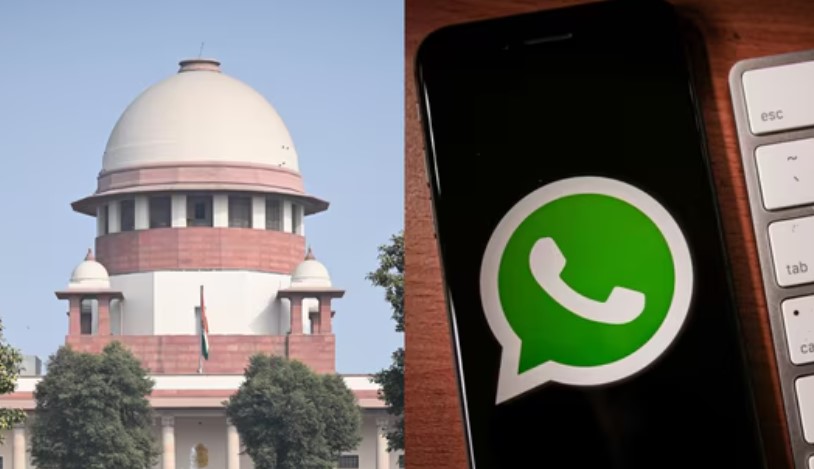
“You can’t play with the right to privacy of citizens of this country in the name of data sharing,” the Supreme Court told Meta.
The Supreme Court on Tuesday pulled up WhatsApp and its parent company Meta over concerns of user data sharing, asserting that citizens’ right to privacy cannot be compromised in the name of technology or business practices.“You can’t play with the right to privacy of citizens of this country in the name of data sharing,” the court told the tech giant, reported PTI.
The top court further questioned Meta's argument on user consent and opt-out mechanisms. Coming down strongly on the issue, the bench remarked that asking where the question of opting out arises amounts to “a decent way of committing theft of private information.”
Expanding the scope of the case, the Supreme Court made Ministry of Electronics and Information Technology (MeitY) a party to the proceedings and said it would pass interim orders on February 9.
The court make the observation while hearing pleas by WhatsApp and its parent Meta. The appeals challenge a Competition Commission of India (CCI) order imposing a penalty over WhatsApp’s “take it or leave it” privacy policy, reported PTI.
Cleverly crafted policy’
During the hearing, the top bench observed that the privacy terms of major technology companies are “so cleverly crafted that citizens will not understand”, and questioned the very premise of user consent, asking “where is the question of opt-out”.
Reiterating its sharp criticism, the court said, “Where is the question of opting out? This is decent way of committing theft of private information,” underlining that such practices cannot be justified under the guise of data sharing or user acceptance.
Case over ‘take it-or-leave it’ nature
The dispute traces back to WhatsApp’s 2021 privacy policy update, which triggered regulatory scrutiny over how user data was being handled and shared within the Meta group.
The National Company Law Appellate Tribunal (NCLAT) in November last year, upheld the Competition Commission of India (CCI)’s penalty of ₹213.14 crore on WhatsApp and its parent company, Meta, for abusing their dominant market position through the policy change.
A bench led by NCLAT chairperson Justice Ashok Bhushan and technical member Arun Baroka agreed with the CCI’s conclusion that the 2021 update effectively compelled users to permit data sharing across Meta’s platforms in order to continue using WhatsApp.
While the tribunal set aside the CCI’s direction that barred WhatsApp from sharing user data with Meta and its group companies for advertising purposes for five years, it otherwise upheld the regulator’s findings on abuse of dominance.
The tribunal found that the “take-it-or-leave-it” nature of the policy imposed unfair and exploitative conditions on users, leaving them with no real choice but to accept data sharing with Meta entities.
The CCI had taken suo motu cognisance of the policy change, concluding that the “broad and vague” data-sharing provisions curtailed user choice and amounted to an abuse of WhatsApp’s dominant position.


comments


Other categories
Recent Comments