


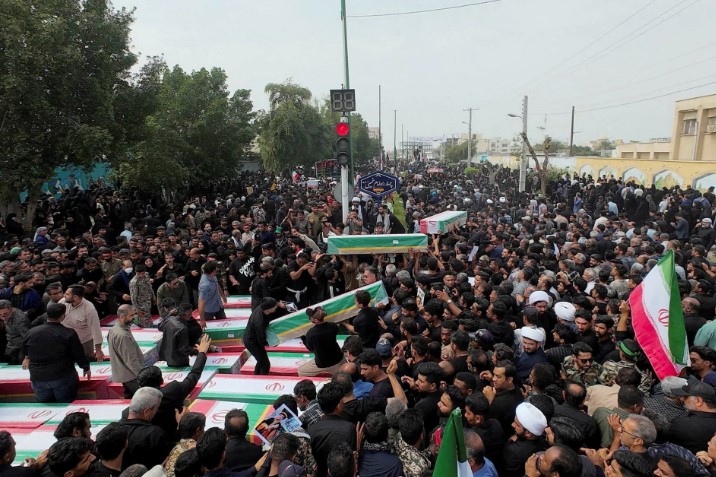
There has been no let-up in firing from either side despite US President Donald Trump giving two deadlines to Iran, which has mocked the ultimatums.
A month on, the drone-missile exchange still continues to rattle the entire Gulf region and affected areas beyond in a conflict triggered by the US-Israeli strikes on Iran on February 28 and intensified by Iranian retaliation.
There has been no let-up in firing from either side despite US President Donald Trump giving two deadlines to Iran, whose retaliatory strikes have virtually closed Strait of Hormuz – the key waterway through which a fifth of world's gas and oil requirements travel. Track latest in US-Iran war here
Multiple crucial energy producing sites across the oil-and-gas-rich Gulf have been targeted in the drone and missile salvo, glittering UAE cities such as Dubai and Abu Dhabi have also been affected by projectiles while over 1,200 have reportedly been killed over a month.
A month of US-Iran war | Where things stand
How did it all start: The surprise US-Israeli strikes on Iran on February 28 triggered the massive conflict in which several top Iranian officials and leaders — including Supreme Leader Ayatollah Ali Khamenei — have lost their lives. In Iran, more than 1,900 people have been killed, while 19 have been reported dead in Israel, according to an Associated Press report, which cited authorities. Two dozen people have been killed in Gulf states and the occupied West Bank. In Lebanon, officials reportedly said more than 1,200 people have been killed, and more than 1 million have been displaced. This is the second attack on Iran by US in President Donald Trump’s second term.
The US previously attacked Iran during high-level diplomatic talks over its nuclear programme in June last year.Strait of Hormuz closure: The key waterway through which 20 per cent of world's gas and oil requirements travel have been in the eye of the Middle East storm. Multiple vessels carrying oil and gas have been stranded around the strait amid Iran chokehold which has sent oil prices skyrocketing and roiled world markets. While some vessels have managed to cross the Strait of Hormuz and dock at countries, including India, many have been targeted by missiles and drones amid Iran's warnings. The first major attack on a vessel was the US submarine strike on Iranian naval frigate IRIS Dena on March 4 off the Sri Lanka coast, an incident in which over 80 died.
Another Strait at risk: Houthi of Yemen officially entered the war on Saturday, announcing that they fired two missiles at Israel. Houthis, Yemeni fighters backed by Iran, previously disrupted shipping lanes in the region, attacking vessels in the Red Sea in retaliation for Israel’s war against Hamas. Any Houthi attacks again on shipping routes in the Red Sea and the Bab al-Mandab Strait would disrupt traffic through the Suez Canal, a crucial waterway for vessels bearing oil, gas and sundry goods to the Mediterranean Sea. As of now there is no specific Houthi blockade; the strait is open to all vessels, including those flying the American or Israeli flags.
Trump's deadlines: Amid the unending drone-missile salvo, US President Donald Trump said on March 23 he has ordered a five-day pause in strikes on Iranian energy infrastructure, and days later extended the deadline — “on Iran government request” — by 10 days to April 6 later, calling for the opening of Strait of Hormuz. Iranian officials and official social media handles linked to the country mocked the deadline and claims of ceasefire talks, saying Trump was probably negotiating with himself. On March 25, a top Iranian military spokesperson asked Donald Trump if he was negotiating with himself, taking a dig at several statements made by the US President over talks he said were going to take place to reach a ceasefire deal after weeks of drone and missile exchange. “Have your internal conflicts reached the point where you are negotiating with yourselves?” Lt. Col. Ebrahim Zolfaghari said in a video message.
Pakistan offers to mediate, Iran calls it a cover-up: Pakistan hosted the foreign ministers of Saudi Arabia, Turkey and Egypt on Sunday to discuss the Middle East conflict and said Islamabad was ready to facilitate peace talks between the US and Iran in the coming days. Iran was missing from the talks. Trump said the US is negotiating with Iran’s parliamentary speaker, Mohammad Bagher Qalibaf, in an interview with the New York Post published Monday. The former Revolutionary Guard commander was previously floated as Washington’s negotiating partner, but has denied Iran is talking to the US and said Pakistan-facilitated discussions were merely a cover for American troop deployments.
Kharg Island in focus: Amid the strikes on energy infrastructure, Trump has said this week that “great progress is being made” in talks with Iran to end military operations. But he said if a deal is not reached “shortly,” and if the Strait of Hormuz is not immediately reopened, the US would broaden its offensive by “completely obliterating” power plants, oil wells, Kharg Island and possibly even desalination plants. The US has also sent a contingent of 2,500 Marines to the region, and another is on its way, while ordering 1,000 paratroopers to the theatre as well. Trump has openly talked about the possibility of trying to seize Kharg Island, Iran's main oil export hub.
Glittering Gulf on edge: The Gulf continues to stay on edge as the war breaches the one-month mark, with almost all countries in the region - Kuwait, Qatar, UAE, Bahrain, Saudi Arabia and Iraq reporting attacks. Cities that were seen as some of the safest places in the world and unaffected by whatever happens in the rest of the Middle East — Dubai and Abu Dhabi — are also not untouched by the Iran war. The cities and other parts of the UAE continue to intercept drones and missiles. The buzzing property market in cities like Dubai, which for decades sold themselves as insulated bubbles in a turbulent Middle East, is also under pressure and becoming cautious due to the disruptions caused by the US-Iran war.


comments


Other categories
Recent Comments