


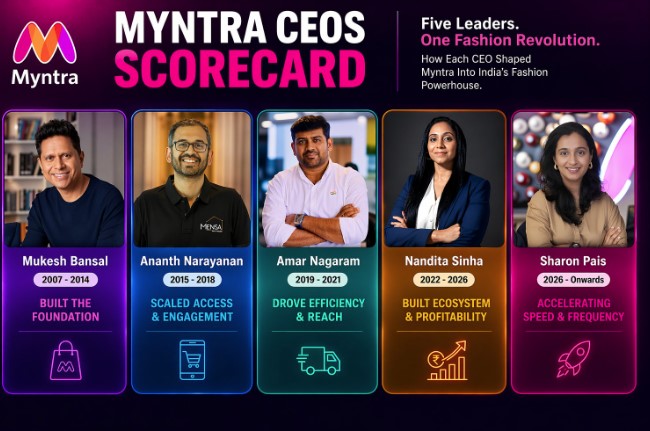
There was a time when fashion e-commerce in India was defined by hesitation. Consumers browsed but rarely converted, unsure of fit, quality, and delivery reliability. What Myntra has done over nearly two decades is systematically remove that hesitation—first by building trust, then by scaling access, then by refining economics, and eventually by shaping behaviour.
Today, Myntra operates at a scale that few category-first businesses have achieved. The platform has crossed ₹6,000+ crore in FY25 revenue and is trending towards ₹7,200+ crore in FY26, with profitability strengthening significantly. It now serves ~200 million annual active users, peaks at ~80 million monthly active users during high-traffic periods, reaches 19,000+ pincodes, and hosts 9,700+ brands, offering over 4 million styles.
It has evolved into a full-stack fashion ecosystem, combining brand partnerships, logistics, content-led discovery, and increasingly, rapid fulfilment.
Just as significantly, Myntra has emerged as India’s most effective digital gateway for global fashion and beauty brands, enabling them to enter, scale, and test omnichannel strategies in the market.
This evolution has not been linear. Each CEO inherited a partially built system and addressed its most immediate constraint. The result is a business constructed in layers—each reinforcing the next.
With Sharon Pais stepping in after Nandita Sinha, Myntra now enters a phase where the challenge is not building capability, but increasing its velocity—how often, how fast, and how seamlessly consumers transact.
The CEO Scorecard: A Platform Built in Phases
|
CEO |
Tenure |
Strategic Lens |
What It Enabled |
|
Mukesh Bansal |
2007–2014 |
Trust & category creation |
Made fashion e-commerce viable |
|
Ananth Narayanan |
2015–2018 |
Mobile & private labels |
Scaled engagement and margins |
|
Amar Nagaram |
2019–2021 |
Efficiency & integration |
Enabled pan-India scale |
|
Nandita Sinha |
2022–2026 |
Monetisation & ecosystem |
Delivered profitability, global scale |
|
Sharon Pais |
2026– |
Speed & frequency |
Driving next growth curve |
Mukesh Bansal: Building the Foundations of Trust and Structure
Myntra’s earliest challenge was behavioural. Fashion required confidence in fit and feel—elements that could not be experienced digitally. The company responded by building one of India’s first standardised fashion catalogues, investing in high-quality imagery and structured product information across thousands of SKUs.
The introduction of easy returns at scale turned uncertainty into experimentation, creating early repeat behaviour.
At the same time, Myntra focused on brand aggregation, onboarding over 1,000 labels and recreating the breadth of a multi-brand retail environment online. This positioned Myntra as a fashion-first destination, rather than a transactional marketplace.
By the time Flipkart acquired Myntra in 2014, the company had already solved the hardest problem—making fashion e-commerce repeatable and scalable in India.
Ananth Narayanan: Rewiring the Platform for Mobile Consumption
The next inflection came with mobile. Myntra moved decisively to become a mobile-first platform, redesigning its experience around personalised discovery, push-led engagement, and feed-based browsing.
This phase saw rapid expansion into Tier-2 and Tier-3 markets, laying the foundation for its current nationwide footprint. It also marked Myntra’s early role as a digital entry platform for international brands, enabling them to access Indian consumers without large offline investments.
Private labels such as Roadster and HRX scaled into large digital-first brands, improving margins and giving Myntra greater control over inventory cycles and pricing.
The platform emerged as a high-engagement, mobile-native ecosystem, even as profitability remained a longer-term goal.
Amar Nagaram: Making Scale Efficient and Omnichannel-Ready
By 2019, Myntra’s scale introduced new complexities—millions of SKUs, thousands of sellers, and a rapidly expanding customer base. The focus shifted toward efficiency and operational discipline.
Integration with Flipkart’s logistics network enabled Myntra to serve 19,000+ pincodes, making organised fashion accessible across much of India. Improvements in inventory allocation, demand forecasting, and fulfilment efficiency reduced cost per transaction and improved delivery timelines.
This phase also marked Myntra’s evolution into an omnichannel enabler for brands, allowing them to:
* Launch digitally
* Validate demand
* Integrate online and offline inventory
Premium and international brands increasingly used Myntra as a brand-building platform, not just a sales channel.
Nandita Sinha: Scaling Global Brand Partnerships and Delivering Profitability
Nandita Sinha’s tenure represents Myntra’s most expansive phase—both in scale and strategic positioning.
By 2025, Myntra had built a portfolio of 450+ international brands, adding 40+ global labels in a single year, including NEXT, Bershka, GAP, DKNY, The North Face, Love Moschino, and Ben Sherman, alongside beauty brands such as The Ordinary, Sulwhasoo, and Beauty of Joseon.
Nearly 45% of international brand demand now comes from Tier-2 and Tier-3 markets, signalling a shift in premium consumption beyond metros. Cities such as Jaipur, Lucknow, Indore, and Guwahati have emerged as strong demand centres, driven by Gen Z and rising digital adoption.
Myntra evolved into a full-stack market-entry platform for global brands, offering:
* Nationwide digital reach
* Data-led localisation
* Integrated logistics and fulfilment
* Pathways to offline and phygital expansion
Speed became a key enabler. Through M-Express, nearly 50% of international brand orders are delivered within 48 hours, while M-Now introduced near-instant fulfilment.
Large-scale events like EORS continued to drive demand at scale, with ~20 million users expected during peak editions and ~1.35 million new customers added, supported by kirana-integrated last-mile delivery networks.
Beauty emerged as a major growth engine, expanding at 2.5x the pace of the online luxe beauty market, with K-beauty witnessing ~200% growth.
These shifts, combined with cost discipline, led to a dramatic financial turnaround:
* ₹6,042+ crore revenue (FY25)
* ₹548+ crore profit (18x growth)
* Strong contribution from high-margin segments like advertising and premium categories
This phase firmly established Myntra as a profitable, globally relevant fashion platform.
Sharon Pais: Driving the Next Curve—Speed, Frequency, and Scale Efficiency
Sharon Pais takes over a business that has achieved scale, engagement, and profitability—rare alignment in Indian e-commerce.
The next challenge is frequency.
Myntra’s rapid delivery initiative, M-Now, reflects this shift:
* ~10% of orders in active markets
* 80+ dark stores
* 940+ pincodes covered
* 35 million+ visitors
* ~20% penetration
With deliveries as fast as 10 minutes, the model introduces impulse-led fashion consumption, reshaping how the category behaves.
At the same time, Myntra’s social commerce initiatives already contribute 10%+ of revenue, with ambitions to scale further through a growing creator ecosystem.
This evolution aligns with the broader strategy under Walmart, where profitability, scale, and IPO readiness for Flipkart are key priorities. Myntra, with its improving margins and premium positioning, is central to that narrative.
What Myntra Has Built—and What Comes Next
Myntra has evolved into a category-first fashion ecosystem, combining scale, reach, and brand depth. With 19,000+ pincodes, 9,700+ brands, and a strong portfolio of global labels, it enables digital, physical, and hybrid brand expansion at scale.
More importantly, it has reshaped fashion consumption—from occasional purchases to continuous, digital-first discovery and buying.
Operating from this position of strength, the next phase is about intensifying usage rather than expanding reach—increasing purchase frequency, expanding rapid delivery, deepening global brand partnerships, and strengthening phygital models.
If the first decade made fashion accessible, and the second made it engaging and profitable, the next phase is likely to make it immediate and habitual.


comments


Other categories
Recent Comments