


Giant Gas Planets Push the Limits of Planet Formation
Gas giants are enormous planets made mostly of hydrogen and helium. Even though they likely contain dense cores, they do not have solid surfaces like Earth. In our solar system, Jupiter and Saturn are the best-known examples, but astronomers have discovered many giant exoplanets beyond our solar system, including some that are far larger than Jupiter. The biggest of these worlds begin to overlap with brown dwarfs — objects often described as “failed stars” because they do not sustain hydrogen fusion.
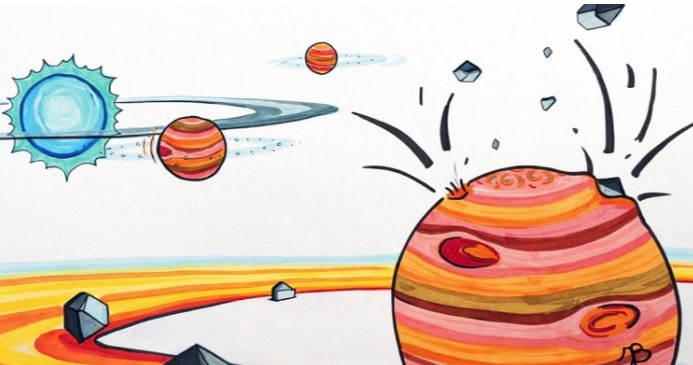
Scientists have long debated how these giant planets form. One theory, known as core accretion, suggests that rocky and icy material slowly gathers inside a disk surrounding a young star. Over time, this growing core becomes massive enough to pull in huge amounts of gas, creating a giant planet like Jupiter or Saturn. Another possibility is gravitational instability, where part of the gas disk rapidly collapses and forms a massive object in a process more similar to star formation.
Researchers led by the University of California San Diego used observations from the James Webb Space Telescope (JWST) to investigate this mystery in the HR 8799 star system. Their findings, published in Nature Astronomy, point toward an unexpected answer.
HR 8799 and Its Massive Exoplanets
The HR 8799 system sits about 133 light-years away in the constellation Pegasus. Its planets are enormous, ranging from five to ten times Jupiter’s mass. They orbit very far from their host star at distances between 15 and 70 astronomical units. Even the innermost planet is 15 times farther from its star than Earth is from the Sun. The planet masses range from 5−10 MJup, meaning the smallest world in the system is still five times more massive than Jupiter.
Astronomers often describe HR 8799 as an oversized version of our solar system because it contains four outer giant planets similar in arrangement to Jupiter through Neptune. However, the planets’ extreme masses and wide orbits created a problem for older theories of planet formation. Traditional core accretion models suggested planets this massive would not have enough time to form before the young star cleared away the surrounding disk of gas and dust.
Did You Know?
What’s the difference between a gas giant, brown dwarf and star? It comes down to a few factors:
Mass: Stars are the most massive (80 MJup+), then brown dwarfs (13-80 MJup), then gas giants (below 13 MJup) [MJup = 1 Jupiter mas
Processing power: Stars fuse hydrogen, which produces intense heat and light; brown dwarfs can fuse deuterium, which produces much less intense heat and light; gas giants have no nuclear fusion
Formation: Stars and brown dwarfs form through the direct collapse of an interstellar cloud of gas and dust, while planets form in the disk of material surrounding new-born stars. Planets first accrete tiny pebbles to form a core, which is then followed by runaway accretion of the surrounding gas to form gas giants.
Processing power: Stars fuse hydrogen, which produces intense heat and light; brown dwarfs can fuse deuterium, which produces much less intense heat and light; gas giants have no nuclear fusion
Formation: Stars and brown dwarfs form through the direct collapse of an interstellar cloud of gas and dust, while planets form in the disk of material surrounding new-born stars. Planets first accrete tiny pebbles to form a core, which is then followed by runaway accretion of the surrounding gas to form gas giants.
JWST Reveals Clues in Alien Atmospheres
To study these distant worlds, astronomers used spectroscopy — the analysis of light to determine the composition and properties of objects in space. Before JWST, scientists mainly relied on ground-based telescopes to measure molecules such as water and carbon monoxide in exoplanet atmospheres. But researchers eventually realized that molecules containing carbon and oxygen are not the best indicators of how planets form because their origins are difficult to trace.
Instead, the team focused on more stable materials known as refractory elements. Sulfur is one of these elements and exists only in solid material within the protoplanetary disk where planets take shape. Finding sulfur in a gas giant atmosphere strongly suggests the planet formed through core accretion.
“With its unprecedented sensitivity, JWST is enabling the most detailed study of the atmospheres of these planets, giving us clues to their formation pathways. With the detection of sulfur, we are able to infer that the HR 8799 planets likely formed in a similar way to Jupiter despite being five to ten times more massive, which was unexpected,” stated Jean-Baptiste Ruffio, a research scientist at UC San Diego and first co-author of the paper.
HR 8799 is also relatively young at about 30 million years old (for reference, our solar system is about 4.6 billion years old). Young planets remain hotter and brighter than older ones, making them easier to study with spectroscopy.
JWST’s spectrograph provides extremely high-resolution observations from space, avoiding interference from Earth’s atmosphere. For the first time, astronomers identified detailed signatures from several rare molecules in the atmospheres of the system’s three inner gas giants that had previously remained hidden.
Detecting Sulfur and Hydrogen Sulfide
The discovery required overcoming major technical challenges. The planets are about 10,000 times dimmer than their host star, and JWST’s spectrograph was not originally designed for this kind of observation. Ruffio developed new data analysis methods to separate the faint planetary signals from the overwhelming starlight. Jerry Xuan, a 51 Pegasi b Fellow at UCLA, built advanced atmospheric models to compare against the JWST observations and determine whether sulfur was present.
“The quality of the JWST data is truly revolutionary, and existing atmospheric model grids were simply not adequate. To fully capture what the data were telling us, I iteratively refined the chemistry and physics in the models,” he said. “In the end, we detected several molecules in these planets — some for the first time, including hydrogen sulfide.”
The clearest evidence of sulfur appeared on the planet HR 8799 c, although researchers suspect sulfur exists on all three inner planets. The team also discovered that these planets contain more heavy elements, including carbon and oxygen, than their parent star. That enrichment provides additional support for the idea that the objects formed as planets.
Rethinking the Limits of Planet Size
“There are many models of planet formation to consider. I think this shows that older core accretion models are outdated,” stated UC San Diego Professor of Astronomy and Astrophysics Quinn Konopacky, another of the paper’s co-authors. “And of the newer models, we are looking at ones where gas giants can form solid cores really far away from their star.”
According to Ruffio, HR 8799 remains unusual because it is currently the only directly imaged system known to contain four massive gas giants. However, astro
nomers have identified other systems with even larger companions whose origins are still uncertain.
“I think the question is, how big can a planet be?” he stated. “Can a planet be 15, 20, 30 times the mass of Jupiter and still have formed like a planet? Where is the transition between planet formation and brown dwarf formation?”


comments


Other categories
Recent Comments