


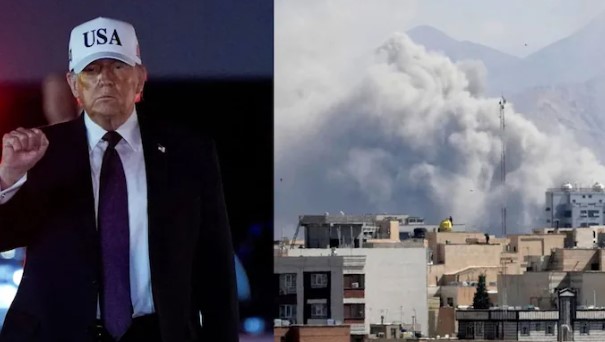
Trump had earlier said in a post on Truth Social that Iran will clear mines it laid in the Strait of Hormuz, US will lift its naval blockade and ships will start moving.
New Delhi:
Undeterred by the spiralling global energy markets and a shadow looming over his ratings ahead of the November midterms, US President Donald Trump on Saturday walked out of a two-hour White House Situation Room meeting without any decision on a potential deal to end the Iran war.
A senior administration official told the New York Times that though a deal is close, matters including unfreezing of funds for the Iranians are being deliberated upon. "The Situation Room meeting has concluded and lasted approximately two hours. President Trump will only make a deal that is good for America and satisfies his red lines. Iran can never possess a nuclear weapon," a White House official said in a statement.
Ahead of the meeting, Trump had said that he was walking into the meeting to make a "final determination" on how to proceed with the potential ceasefire, though a stand-off with Tehran sees no signs of easing amid disagreements of the opening of the Strait of Hormuz and Iran's nuclear program, among other issues.Trump said in a post on Truth Social that Iran will clear mines it laid in the Strait of Hormuz, US will lift its naval blockade and ships will start moving. He added that Iran's highly enriched uranium, will be unearthed and destroyed. "No money will be exchanged, until further notice," he said, referring reports that Tehran was demanding "the immediate release of $12 billion in frozen Iranian assets" before moving to the next phase of negotiations.
What Iran Has Said
Iranian Foreign Ministry spokesman Esmaeil Baghaei said that no agreement has been finalised with the United States yet and the exchange of messages between the two sides is continuing. Baghaei made the remarks in a telephone interview with state-run IRIB TV that Iran's current focus in the negotiations "is on ending the war". "We have no talk on details of the issues pertaining to Iran's uranium enrichment or enriched uranium at this stage," he said.
Speaking about the possible re-opening of the Strait of Hormuz, Baghaei said future management of the strait "concerns only Iran and Oman". He said the Islamic republic "said goodbye to the language of 'must' 47 years ago."
Following a week of tit-for-tat strikes after a delicate ceasefire that was reached on April 8, Iran's lead negotiator Mohammad Bagher Ghalibaf wrote on social media, "We do not gain concessions through dialogue, but through missiles." He said Iran had "no trust in guarantees or words", adding that "no step will be taken before the other side acts first."
Ebrahim Azizi, who heads the Iranian parliament's national security commission and is close to top leaders, posted on social media Friday that Iran "sets the terms: cash for cash, credit for credit, nothing for nothing."
Key Demands
Iran's nuclear stockpile: US has demanded that Iran stops enriching uranium and hands over its enriched uranium to another country. The Islamic Republic has 440.9 kilograms of uranium that is enriched up to 60 per cent purity, a short, technical step from weapons-grade levels of 90 per cent, according to the International Atomic Energy Agency. It is believed to be buried under three nuclear sites that were bombed by the US last year.
Strait of Hormuz reopening: US has sought the reopening of the critical waterway through which 20 per cent of the world's oil passes. It has also sought the removal of mines within 30 days. Iran has laid claim over the chokepoint, asserting that Oman and Tehran have the authority to extract toll from ships passing through the Strait of Hormuz.
Israel-Hezbollah truce: Iran wants any deal to include a truce between Israel and Iran-backed Hezbollah in Lebanon, where fighting has intensified despite a nominal ceasefire.
Release of frozen funds: The Tasnim news agency reported that Iran was seeking the release of around $24 billion in frozen Iranian assets abroad as part of the agreement. Around $12 billion "should be made available at the start of the announcement of the memorandum", Tasnim said. There is no official figure for Iran's frozen overseas assets, though Iranian media outlets have recently estimated the total at between $100 billion and $123 billion.
Guarantees: One of Tehran's key demands has been guarantees that Washington will honour any agreement - after the United States withdrew from a landmark 2015 nuclear deal during Trump's first term in office. Iran's top negotiator has also expressed scepticism about US guarantees, saying Tehran would trust only Washington's concrete actions, not its words.
Ceasefire Broken
A ceasefire in the Middle East came to be on April 8, at a time Trump faced questions on needing to seek Congressional approval to continue the war against Iran.
As recently as this week, Washington and Tehran have accused each other of violating the truce in and around the strait, with US strikes on the southern Iranian port of Bandar Abbas countered by retaliatory Iranian fire.


comments


Other categories
Recent Comments