


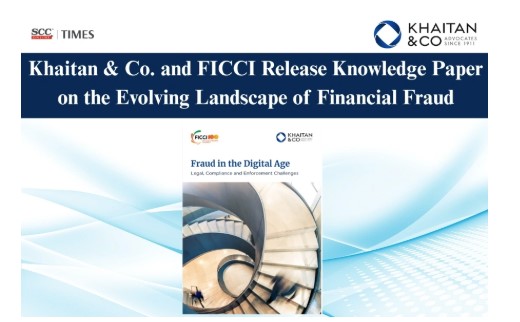
Launched at the FICCI Next-Gen Forensics Conference, the paper examines India’s fraud investigation framework and the growing challenges of technology-enabled financial crime
Financial fraud in India is becoming increasingly sophisticated as digital transactions continue to see exponential growth. Against this backdrop, Khaitan & Co and FICCI have jointly unveiled “Fraud in the Digital Age: Legal, Compliance and Enforcement Challenges” at the FICCI Next-Gen Forensics Conference in Mumbai. The knowledge paper examines how technology, evolving fraud typologies and changing financial ecosystems are testing the effectiveness of traditional legal and enforcement frameworks in India.
Speaking at the event, Amey Mirajkar, Partner, Khaitan & Co said, “India’s digital economy is expanding at an extraordinary pace, but the same infrastructure that enables faster and efficient financial transactions is also being exploited by increasingly sophisticated fraud networks. Investigations today routinely involve virtual assets, encrypted communications, digital evidence and cross-border networks, creating challenges for businesses, regulators and enforcement agencies alike. The knowledge paper examines how legal and compliance frameworks can adapt to address these emerging risks more effectively”.
The digital payment ecosystem has witnessed remarkable growth over the past decade, with transaction volumes increasing 38-fold. According to the Reserve Bank of India’s Annual Report 2024—25, bank frauds involving more than INR 36,000 crore were reported during FY25, while cyber-enabled fraud emerged as one of the fastest-growing categories of financial crime. The paper analyses:
Legal and regulatory framework governing fraud investigations
Role of key enforcement agencies in addressing increasingly sophisticated fraud risks
Emerging issues relating to digital evidence, cryptocurrency-linked offences, AI-enabled fraud, deepfakes and organised cybercrime
Key laws and judicial trends
Global best practices from United States, United Kingdom and Singapore
As financial crime continues to evolve, the paper calls for a shift from a reactive model of enforcement towards a more proactive and intelligence-led approach to prevention and risk management.


comments


Other categories
Recent Comments