


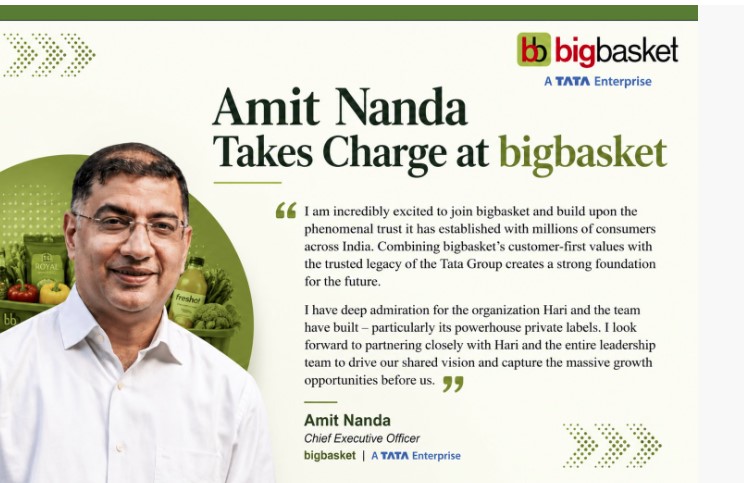
The former Amazon executive takes charge of BigBasket as India's largest online grocer looks to strengthen quick commerce, scale private labels and improve profitability amid rising competitive pressures.
BigBasket enters its next chapter with a new chief executive and a familiar challenge: how to sustain rapid growth while building a more profitable business.
Amit Nanda has been appointed CEO of BigBasket, succeeding co-founder Hari Menon, who will continue to remain involved as a board member and mentor. The leadership change comes after a defining phase in the company's journey—from pioneering online grocery in India to becoming a key pillar of Tata Digital's commerce ambitions.
Nanda takes charge of a business that has achieved significant scale. BigBasket reported FY25 revenue of ₹9,866.7 crore while posting a net loss of ₹2,006.8 crore. The numbers underline both the strength of the franchise and the pressures facing the online grocery and quick commerce sector, where companies continue to invest heavily in customer acquisition, fulfilment infrastructure and faster delivery networks.
The leadership transition also comes at a time when Tata Group is sharpening its focus on profitability across its digital businesses. Tata Sons Chairman N. Chandrasekaran has repeatedly emphasised the importance of building sustainable digital ventures with clear pathways to profitability and long-term value creation.
In that context, Amit Nanda's appointment appears carefully aligned with the next set of priorities for BigBasket.
Unlike many executives who have spent their careers solely in e-commerce, Nanda brings experience spanning consumer goods, consumer banking, technology-led businesses and large-scale marketplace operations. Most recently, he spent nearly a decade at Amazon, where he held leadership roles across multiple business functions and helped build and scale consumer-facing businesses in one of the world's most competitive digital commerce environments.
His background suggests that BigBasket's next phase may focus as much on operational efficiency, customer retention and margin improvement as on topline growth.
The Private Label Advantage
One of BigBasket's strongest assets is its private-label portfolio.
Over the years, the company has built brands such as Fresho, bb Royal, bb Popular, bb GoodDiet and Tasties into meaningful businesses in their own right. Unlike many online retailers that depend heavily on third-party brands, BigBasket has invested consistently in developing its own products across staples, packaged foods, fresh produce and household categories.
Private labels offer several strategic advantages. They provide higher margins, improve customer stickiness, create differentiation and give retailers greater control over sourcing and quality.
Nanda himself acknowledged this strength in his first statement as CEO, describing BigBasket's private-label business as one of the company's most admired assets.
As competition intensifies across quick commerce, private brands could become an increasingly important lever for improving profitability while deepening customer loyalty.
Beyond the Quick Commerce Race
The Indian quick commerce market has become one of the most fiercely contested segments in retail.
Blinkit, Zepto, Swiggy Instamart, Flipkart Minutes and several other players continue to expand aggressively through dark-store networks and rapid delivery models. Consumers have embraced the convenience of receiving groceries and daily essentials within minutes, creating a market that is growing faster than most retail categories.
BigBasket initially approached quick commerce more cautiously before accelerating investments through BB Now and related initiatives. Today, it competes directly with some of the most heavily funded players in the ecosystem.
Yet speed alone is unlikely to determine long-term success.
As the category matures, investors and boards are expected to place greater emphasis on unit economics, fulfilment efficiency, customer lifetime value and profitability. The companies that succeed will need to balance convenience with sustainable business fundamentals.
This is where Nanda's Amazon experience could prove particularly valuable. Amazon's operating model has long emphasised customer obsession, process discipline, data-driven decision-making and long-term economics. Those capabilities are increasingly relevant in an industry where growth is no longer the only metric that matters.
A Strategic Asset Within Tata's Digital Ecosystem
BigBasket occupies a unique position within Tata Digital's portfolio.
Unlike many digital businesses that are still searching for scale, BigBasket already operates a nationwide sourcing and fulfilment network, serves millions of customers and enjoys strong brand recognition in grocery retail. It also participates in one of the highest-frequency consumption categories, ensuring regular engagement with consumers.
This makes BigBasket far more than an online grocery platform. It serves as a strategic gateway into the Tata ecosystem, creating opportunities for cross-selling, loyalty integration and deeper customer engagement across Tata Neu and other group businesses.
The company's scale, supply-chain capabilities and private-label portfolio provide competitive advantages that are difficult to replicate quickly.
The New Mandate
BigBasket's next phase is unlikely to be defined solely by how many dark stores it opens or how quickly it delivers groceries.
The larger opportunity lies in strengthening its position across online grocery, quick commerce and private labels while improving business fundamentals. The company already possesses assets that many competitors would envy—a trusted brand, a nationwide supply chain, deep sourcing capabilities, millions of customers and one of the strongest private-label portfolios in Indian retail.
The task before Amit Nanda is to translate those advantages into stronger economics and sustainable market leadership.
His experience across Amazon, consumer businesses and large-scale operations suggests a leadership style rooted in execution, process discipline and customer-centric innovation. Those capabilities could prove increasingly valuable as competition intensifies and investors focus more closely on profitability and capital efficiency.
For Tata Digital, BigBasket remains one of its most strategic consumer businesses. How effectively it balances growth, margins and customer loyalty over the next few years may offer important clues about the future direction of the group's broader digital commerce ambitions.


comments


Other categories
Recent Comments