


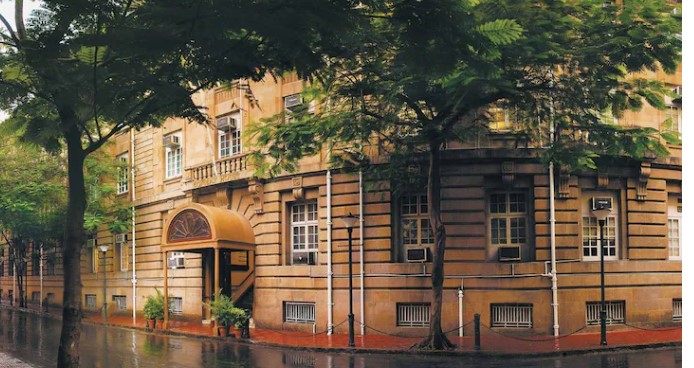
While Made in India: A Titan Story focuses on the rise of Titan and the visionaries behind it, the series has also introduced the audience to Bombay House, a building that stood at the centre of Indian business history for over a century
The recently released series Made in India: A Titan Story has brought audiences back into the world of Titan watches, boardroom decisions and the personalities who helped shape one of India's most successful consumer brands.
Alongside the performances of Jim Sarbh and Naseeruddin Shah, another name has quietly grabbed attention: Bombay House, the historic headquarters of the Tata Group.
The series not only references Bombay House as the nerve centre of crucial corporate decisions, but it also became the first production to actually film inside the iconic building.According to the show's makers, shooting was carried out with meticulous planning, much like the filming at Titan's operational factory in Hosur, where real watch manufacturing continued on one side of the floor while scenes were filmed on the other without disrupting production.
For many viewers, the series has sparked curiosity about Bombay House itself, a building that has witnessed some of the most important moments in Indian corporate history over the last century.
The Heart Of The Tata Empire
Located at Homi Mody Street in Mumbai's Fort district, Bombay House has served as the headquarters of the Tata Group since 1924.
The story began in 1920 when Sir Dorabji Tata, the group's second chairman, purchased a plot from the Bombay Municipality and handed it over to The Associated Building Company.
The task of designing the structure went to Scottish architect George Wittet, the man behind some of Mumbai's most recognisable landmarks, including the Gateway of India and the Chhatrapati Shivaji Maharaj Vastu Sangrahalaya.
Construction was completed in July 1924, creating what would become one of India's most significant corporate addresses.
Interestingly, the building was never named "Tata House". RD Tata, father of JRD Tata, chose the name Bombay House despite suggestions to name it after the family. The decision reflected the group's attachment to the city where its journey began.
An Edwardian Landmark
At first glance, Bombay House appears much as it did nearly a century ago even now.
The four-storey structure is built from Malad stone and follows the Edwardian neo-classical architectural style popular during the late colonial era. Despite extensive modernisation inside, the exterior facade remains unchanged, preserving its historic character.
The building's architecture reflects Wittet's trademark approach: symmetry, restrained ornamentation and a sense of quiet grandeur. Deep cornices, stone masonry and Georgian-style windows contribute to its timeless appearance.
Inside, however, visitors encounter a different world. French chandeliers, French pendulum wall clocks and elegant teakwood furniture create a distinctly colonial atmosphere. Bombay House combines European grandeur with unmistakable Indian warmth.
Where History-Making Decisions Were Made
For more than 100 years, Bombay House has been the site of some of the Tata Group's most consequential decisions.
It was from here that Dorabji Tata expanded the business beyond its early ventures into sectors such as insurance, soaps, detergents and cooking oil.
The building also witnessed the conceptualisation of India's first airline in 1932 under the leadership of JRD Tata. Decades later, it became the command centre for one of the biggest overseas acquisitions by an Indian company when Tata Steel acquired Corus in a deal worth US$13 billion in 2007.
Today, the offices of Tata Sons' chairman and senior leadership continue to operate from the building. Major Tata companies, including Tata Motors, Tata Steel, Tata Chemicals, Tata Power, Tata Industries, Trent and TCS, maintain a presence within its walls.
Around 400 people work in the building.
The Rs 800 Million Transformation
For nearly 94 years, Bombay House remained largely untouched.
That changed in 2017 when Tata Sons chairman N Chandrasekaran initiated the building's first comprehensive restoration and refurbishment.
The project, led by renowned architect Brinda Somaya, had a daunting deadline. The restored headquarters had to reopen on July 29, 2018, the birth anniversary of JRD Tata.
The makeover, costing approximately Rs 800 million, transformed the building's interiors while preserving its heritage character.
Rather than simply modernising office spaces, the renovation sought to tell the story of the Tata Group itself.
The building was redesigned around three themes: Evolution, Reflection and Metamorphosis.
The basement and ground floor showcase the group's origins and nation-building legacy. The ground floor houses the Tata Experience Centre, an immersive storytelling space that traces the Tata journey through archives, photographs and interactive exhibits.
The first, second and third floors represent "Reflection". These floors accommodate offices of various Tata companies and were redesigned with open lounges, breakout zones, think-pods and collaborative workspaces to encourage interaction between teams.
The fourth floor symbolises "Metamorphosis" and houses the offices of Tata Sons directors, the chairman's office and the boardroom where future strategies are shaped.
Preserving Heritage
One of the biggest challenges was introducing modern infrastructure into a Grade II heritage building without compromising its identity.
The restoration team cleaned the Malad stone facade using specialised conservation techniques, repaired deteriorated lime mortar, upgraded windows with double glazing and installed modern security, surveillance and technological systems.
Historic elements were carefully preserved. The iconic boardroom table was retained exactly as it was, merely restored and polished. Original wood panelling and windows were also conserved.
The renovation even extended to the terrace, which was transformed into a landscaped area featuring greenery and outdoor seating.
Throughout the process, the guiding principle remained clear: modernise the workplace without erasing history.
The Office That Welcomed Dogs
Perhaps the most charming aspect of Bombay House is not its architecture or business legacy, but its relationship with stray dogs.
For decades, dogs have wandered freely into the building, a tradition that reportedly dates back to JRD Tata's affection for animals.
During renovation discussions, one of Ratan Tata's first concerns was not about office space or technology. It was about the dogs.
When informed about the renovation, he famously asked, "Where will dogs go?"
The question eventually led to the creation of a dedicated kennel on the ground floor. Painted bright yellow, the space includes sleeping areas, bathing facilities, toys and medical care for resident dogs.
The kennel houses several canine residents and remains one of the most unusual features of any corporate headquarters in the world.
As Tata employees often note, these dogs are the only visitors permitted to enter Bombay House without an access card.


comments


Other categories
Recent Comments