


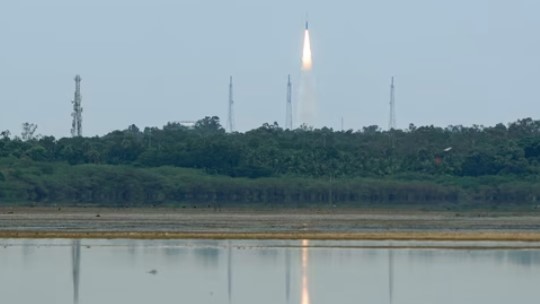
Skyroot Aerospace's achievement is the most visible marker yet of a private sector that has grown from a handful to 400+ startups in India.
India's first privately built rocket lifted off from Sriharikota on Saturday, marking the first time a domestic company has independently reached orbit and joining a small group of private firms globally with such a capability.
Skyroot Aerospace's Vikram-1, a seven-storey, all-carbon-composite launch vehicle, took off from the Satish Dhawan Space Centre at 12:05 pm. Roughly an hour later, the Hyderabad-based company said on X that the rocket had "completed its final burn and injected its payloads into a ~450 km orbit".
The feat, it said, had made India "the third country in the world with private orbital launch capability".
Prime Minister Narendra Modi, in a post on X ahead of the flight, described the mission as "a historic new frontier for India's space journey" and said it reflected how the government's 2020 space-sector reforms were "unlocking new opportunities for innovation and enterprise".
The rocket, the payloads, and a postcard from PM
Vikram-1 is a 24-metre, four-stage vehicle — three stages of solid propulsion topped by a liquid orbital adjustment module that can release multiple satellites into orbit. It is designed to place payloads of up to 350kg into low Earth orbit. The maiden mission targeted an altitude of 450 km at a 60-degree inclination.
"It is 100% designed in India, 100% manufactured in India. We have built it from scratch," Skyroot co-founder and CEO Pawan Kumar Chandana had told HT earlier in the month.
"That means hundreds of systems have to be developed and tested. Everything has to work together to a level where right now we're able to stack it up on the launch pad, and ready to go off and shoot it."
The rocket's airframe is entirely carbon composite — a material "five times lighter than the strongest steel", Chandana told news agency ANI in a separate interview — and its liquid engines are 3D-printed in metal, a manufacturing route the company says compresses hundreds of components into a single printed part.
The vehicle carried technology demonstrator payloads from Grahaa Space, Cosmoserve, DCubed and Skyroot's own SCOPE unit, along with a lab-grown "Diamond Lotus" developed by Bengaluru-based Cosmos Diamonds, according to news agency PTI.
The rocket carried artwork — a tiny gold rocket with micro-sculptures of three of India’s legendary scientists. Each smaller than a grain of rice, the sculptures pay tribute to Nobel Prize-winning physicist CV Raman, aerospace engineer and former president APJ Abdul Kalam, and Vikram Sarabhai, the physicist widely regarded as the father of India’s space programme and after whom the rocket is named. Also on board was a handwritten postcard from PM Modi bearing the words "Vande Mataram”, alongside postcards from engineers, scientists and Indian astronauts.
The single most important objective of Mission Aagaman is to capture the real in-flight performance data from every system on Vikram-1. We want to understand how the vehicle performs from lift-off through every phase of ascent," Chandana had told HT.
"This data cannot be fully replicated through ground testing. It will help us validate our designs and inform subsequent vehicle development as we build a reliable, high-cadence commercial launch programme," he had said.
From an IIT–Isro pairing to a unicorn
Skyroot Aerospace was set up eight years ago by Chandana and co-founder Naga Bharath Daka, both alumni of the Indian Institutes of Technology (IITs) and former Indian Space Research Organisation (Isro) scientists.
The company now employs more than 1,000 people, 400 of them on Vikram-1, Chandana told HT. Its Infinity Campus in Hyderabad, spread over 2 lakh square feet and inaugurated by Modi in November 2025, has capacity to build one orbital rocket a month.
The company's first mission, the suborbital Vikram-S, flew on 18 November 2022 — the first private rocket to reach space from Indian soil. Saturday's flight is only its second.
In May, Skyroot became the first Indian space startup to reach unicorn status, raising $60 million at a valuation of $1.1 billion in a round co-led by Sherpalo Ventures — the venture capital firm of early Google investor Ram Shriram — and Singapore's sovereign wealth fund GIC. Singapore state investor Temasek is also a backer, the country's high commission in India noted in a social media post ahead of the launch.
The company has not disclosed the cost of developing Vikram-1, but Chandana had told HT that raising capital had been "one of the biggest challenges".


comments


Other categories
Recent Comments