

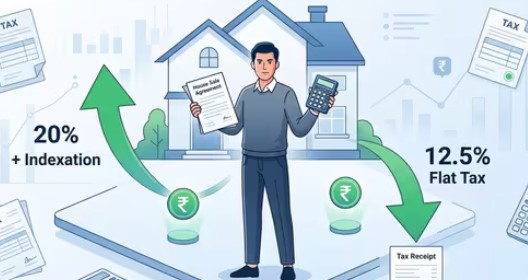
Many property sellers may end up paying more tax under the 20% tax regime with indexation than under the flat 12.5% LTCG tax. The benefit of indexation depends on how much the property's value has appreciated over time, making it important to compare both tax calculations before filing.
Many homeowners assume that claiming indexation automatically reduces their tax bill when selling a property. After all, indexation adjusts the purchase cost for inflation, lowering the taxable capital gains.
However, a simple example shared by Dev Patel, Financial Advisor at 1 Finance, suggests that this may not always be the most tax-efficient option.
In a post on X, Patel explained that for properties purchased before 23 July 2024 and sold during FY 2025-26 (Assessment Year 2026-27), the tax law allows eligible resident individuals and Hindu Undivided Families (HUFs) to compute long-term capital gains tax in two ways—20% with indexation or 12.5% without indexation.
How 12.5% tax rate can reduce your LTCG liability?
To explain the difference, Patel used the example of a property bought in FY 2017-18 for ₹10 lakh and sold in FY 2025-26 for ₹28 lakh.
With indexation, the purchase price is adjusted using thHe explained, “Indexation only rescues you when your property barely beat inflation. The CII rose 38% over those eight years, roughly 4% a year. Your flat nearly tripled. Once your gain runs that far ahead of inflation, the rate cut does more for you than the cost adjustment ever could.”e Cost Inflation Index (CII) from 272 to 376, increasing the cost of acquisition to ₹13.82 lakh. This reduces the capital gain to ₹14.18 lakh, resulting in a tax liability of ₹2.83 lakh.
Without indexation, the taxable gain remains ₹18 lakh, but the flat LTCG tax rate of 12.5% brings the tax liability down to ₹2.25 lakh.
In other words, if a property's value has appreciated significantly over the holding period, the benefit of paying tax at 12.5% can outweigh the reduction in gains achieved through indexation.
Patel added that “for that purchase year, break
The indexation benefit is available only for resident individuals and HUFs selling land or buildings acquired before 23 July 2024.
He further pointed out that properties acquired on or after 23 July 2024 are taxed only at the flat 12.5% rate.
-even sits near ₹20.2 lakh. If you sell below it, then indexation is a better option and vice versa.”
As Patel noted, “The worse option is ₹58,529 cheaper.”


comments


Other categories
Recent Comments