


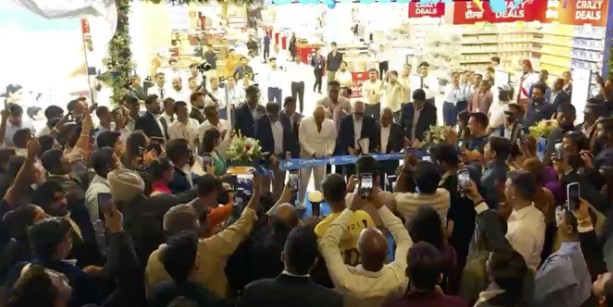
On the eve of Independence Day, Carrefour opens its first India consumer store with 15,000+ SKUs; Apparel Group-backed retailer targets a 50-store North India network
A Very Different Comeback
On 14 August 2026, on the eve of India's Independence Day, Carrefour finally opened the doors to its first consumer-facing store in India, nearly 12 years after the French retail giant exited the country.
Located at H&S Mall, Boulevard Walk, Greater Noida West, the inaugural Carrefour store marks the beginning of its second India innings through a strategic franchise partnership with Dubai-based Apparel Group. And unlike Carrefour's first attempt, which was built around cash-and-carry wholesale, this time the French retailer is going directly after the Indian consumer.
The first store spans 50,000+ sq. ft. and carries more than 15,000 SKUs, combining locally sourced products with exclusive international offerings across fresh produce, grocery, bakery, household essentials and personal care. Carrefour India describes the store as being adapted specifically to local consumers, with a proposition built around quality, value, choice and convenience.
The timing is commercially intriguing. Carrefour's return coincides with one of India's strongest Independence Day shopping periods, when retailers across categories roll out major promotions around the 15 August weekend. For a food-and-grocery retailer making its first impression on Indian consumers, opening on 14 August puts the brand directly into a high-shopping-intent period.
But the significance of the opening goes well beyond its timing. Behind this first store is a global retail company with 15,415 stores worldwide, €43.85 billion in gross sales in the first half of 2026, and a newly assembled Indian retail organisation that includes veterans of Walmart, Spencer's, SPAR, LOTS Wholesale and other large-format businesses.
From Cash-and-Carry to Consumer Retail
Carrefour's first India experiment began in 2010, when foreign multi-brand retail was still heavily constrained by India's FDI regulations. The French retailer entered through the permitted cash-and-carry route and eventually operated five wholesale stores across Delhi, Jaipur, Meerut, Agra and Bengaluru.
It exited in 2014 after struggling to achieve scale and profitability and failing to find a suitable partner for a consumer retail expansion. Carrefour's Patrick Lasfargues subsequently acknowledged that the group's intensity in India had been insufficient at the time and that the company had not been patient enough with the market.
The second attempt is built on an entirely different model. Carrefour is not investing directly in an Indian retail operating company; instead, Apparel Group is its franchise partner and is responsible for building the India retail platform. The original agreement announced in September 2024 envisaged an initial North India focus followed by wider national expansion.
That model also fits Carrefour's broader international partnership strategy. In its latest H1 2026 presentation, Carrefour reported that 4,054 of its 15,415 stores are in franchised countries and regions, illustrating the scale of the partner-led model within its global network.
The First Store Is Bigger Than the Original Blueprint
When Carrefour and Apparel Group announced their India plans, the partners spoke of three formats: supermarkets of around 8,000 sq. ft., compact hypermarkets of around 25,000–30,000 sq. ft., and gourmet stores of around 8,000 sq. ft.
The first store, at more than 50,000 sq. ft., is therefore significantly larger than the compact hypermarket format originally described.
The assortment, meanwhile, reflects Carrefour's stated intention to focus heavily on food while keeping non-food relatively limited. The store's 15,000-plus SKUs include fresh produce, grocery, bakery, household essentials and personal care, alongside international products and locally sourced merchandise.
Early customer response has been encouraging, according to Vipin Bhandari, CEO, Carrefour India. “The response has been very good. Customers are happy and appreciative of the experience in the store, the assortment and, of course, the prices,” he said.
The choice of Greater Noida West also fits the original location strategy. Carrefour had said it would look at both malls and high streets, while concentrating initially on Delhi-NCR. Greater Noida West offers a large and growing residential catchment and a developing retail ecosystem, allowing a hypermarket to function as both a destination and a weekly stock-up store.
The Team Behind Carrefour 2.0
Perhaps the most significant development since the partnership was announced is the leadership bench Carrefour India has assembled.
Veteran food-retail executive Vipin Bhandari is leading the Carrefour India operation as CEO. Having joined the business quietly some time before the launch, Bhandari has been part of the team building Carrefour's India platform ahead of its first store. His previous experience as Managing Director of Max Hypermarkets India, which operated SPAR in the country, gives Carrefour deep Indian large-format food-retail expertise as it moves towards a larger network.
Saurabh Bansal, who joined Carrefour in September 2025 as Chief Merchandising Officer, is another key hire. A retail veteran with more than two decades of experience, Bansal previously served as Executive Director and Chief Merchandising Officer at Spencer's Retail and earlier held senior roles at Walmart and Snapdeal. His experience spans hypermarkets, cash-and-carry, e-commerce and omnichannel retail, with responsibility across FMCG, staples, fresh, home and general merchandise, electronics and fashion.
Amritraj Kaur, appointed Head of Marketing, brings more than 17 years of experience across marketing, brand building, CRM and omnichannel retail. Her earlier leadership roles include BnC Foods, LOTS Wholesale Solutions, Best Price Flipkart Wholesale, Walmart, Future Group, Amira Foods and Spencer's Retail.
Raghu Tiwari has joined as Category Head – Apparel & Fashion, with responsibility spanning buying, merchandising, sourcing, assortment, pricing and category development, while Deepak Gandhi has taken charge as Category Head – General Merchandise, adding further experienced category leadership to the India organisation.
The leadership structure extends well beyond these visible senior appointments, with teams being built across merchandising, category management, sourcing, supply chain, operations, marketing, finance, HR, store management and frontline operations—effectively creating a full retail organisation around the first store.
On the partner side, Nilesh Ved, Chairman of Apparel Group, has been central to the Carrefour partnership, while Tushar Ved, President of Apparel Group India, has been closely involved in the group's Indian expansion strategy. Tushar Ved had earlier described Carrefour as Apparel Group's forthcoming entry into the grocery and supermarket space in India.
Together, the Carrefour-Apparel Group platform now brings something the French retailer did not have during its first India innings: an experienced Indian food-retail leadership team, backed by a global retail engine and a partner with an established India operating platform.
15,415 Stores and €43.85 Billion in Six Months
The size of the parent company puts Carrefour's Indian entry into perspective.
As of 30 June 2026, Carrefour had 15,415 stores under its banners worldwide: 1,112 hypermarkets, 3,819 supermarkets, 9,624 convenience stores, 694 cash-and-carry stores and 108 soft-discount stores, alongside 58 Sam's Club stores in Brazil.
Its first-half 2026 gross sales reached €43.85 billion, while net sales were €39.434 billion. Recurring operating income stood at €757 million, compared with €727 million in H1 2025.
The geographic footprint is equally broad. At the end of Q2 2026, Carrefour had 6,895 stores in France, 1,654 in Spain, 718 in Brazil, 696 in Belgium, 676 in Poland and 722 in Argentina, with another 4,054 stores across franchised countries and regions.
That international partner network is important to understanding the India strategy. Carrefour's model is not necessarily to own and operate every store in every market. Instead, local partners bring market knowledge, capital, real estate relationships and operating expertise, while Carrefour brings the brand, formats, sourcing capabilities, merchandising know-how and global retail systems.
India fits that model almost perfectly.
A ₹-Trillion Grocery Opportunity—but a Brutally Competitive One
Carrefour is returning to an India that bears little resemblance to the country it left in 2014.
Large-format grocery has become an established part of Indian retail. Reliance Retail has created a multi-format food ecosystem; DMart has built an enormous value-led supermarket network; Tata Trent has expanded Star; Lulu has established large-format hypermarkets; and a host of regional players compete for local grocery baskets.
At the other end of the market, quick commerce has fundamentally altered expectations around convenience.
Carrefour therefore cannot rely simply on the novelty of its international name. Its proposition will have to work on the fundamentals of Indian grocery retail: price, assortment, availability, fresh quality, private labels, replenishment, location and basket economics.
Carrefour and Apparel Group had already indicated that private labels would be an important component of the India proposition. Lasfargues pointed out that private labels accounted for 37% of turnover in France, suggesting considerable room for development in India. The partners also said they would source extensively within India and consider local manufacturing of some Carrefour private-label products.
The opportunity could eventually extend beyond selling in India. Lasfargues had said Carrefour was looking at the possibility of exporting from India within five years, potentially making the country part of the retailer's wider sourcing architecture rather than simply a consumer market.
The 50-Store Test
The original India plan was ambitious: Carrefour and Apparel Group said they intended to build 50 stores in the first five years in North India, with Delhi-NCR as the initial cluster and a mix of formats. If other markets became ready and suitable real estate was available, the partners said they would move to a second phase.
That makes the Greater Noida store a particularly important test.
The first store will provide data on everything from Indian consumers' response to the international assortment and private labels to the ideal store size, fresh-food economics, basket size, price positioning and frequency of visits.
The partners have also left the door open to e-commerce and potentially quick commerce. Lasfargues said the business plan would determine whether e-commerce would start immediately or later, while acknowledging that Carrefour's European experience had shown the economics of quick commerce could be difficult.
The eventual India network could therefore look very different from the first store: large hypermarkets where catchments support them, smaller supermarkets for dense urban locations and gourmet or specialty formats in selected markets.
From One Store to an India Retail Platform
The most revealing aspect of Carrefour's comeback may be what happened before the ribbon was cut.
The retailer spent months building a local leadership team, category organisation and store workforce before opening the first doors. That is a marked departure from its first India experiment, when Carrefour entered through wholesale and ultimately left without developing the consumer-facing partnership it had wanted.
The new model combines Carrefour's global retail engine with Apparel Group's Indian market infrastructure, supported by executives who understand India's food, grocery, merchandising and large-format retail businesses.
For Apparel Group, meanwhile, Carrefour is a major diversification into a business whose economics, supply chain and consumer frequency are fundamentally different from fashion and lifestyle retail. But the group already operates a substantial portfolio of international brands in India and has built experience in malls, high streets, franchise operations and local market adaptation.
The choice of H&S Mall, Boulevard Walk is also significant. The development provides Carrefour with a large-format retail platform in a rapidly expanding residential catchment in Greater Noida West. For a retailer looking to establish a destination-led hypermarket, the location combines a substantial surrounding population with a wider retail and leisure ecosystem.
There is, however, no publicly disclosed lease figure or other commercial lease terms for Carrefour's store, so the economics of the deal remain private.
The Second Innings Has Finally Begun
Carrefour left India in 2014 after five cash-and-carry stores. It returns in 2026 with a 50,000-plus-sq.-ft. consumer store, 15,000-plus products, a senior Indian retail leadership team, a powerful franchise partner and a stated ambition of 50 stores in North India.
The symbolism of opening on the eve of Independence Day is hard to miss. But the real test begins after the launch weekend, when the novelty fades and Carrefour has to win repeat grocery missions from Indian households.
The first Carrefour trolley has now moved through the checkout in India.


comments


Other categories
Recent Comments