


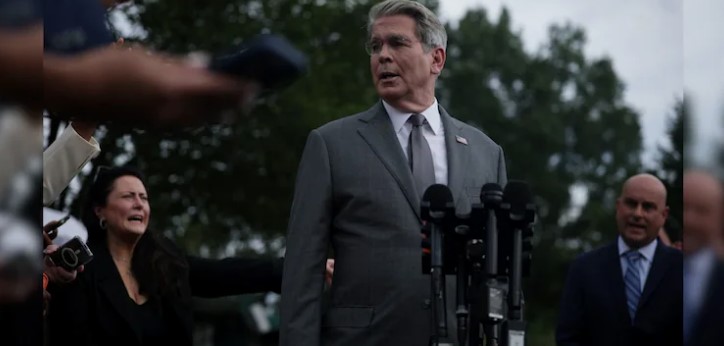
The United States has also warned of "tremendous economic consequences" for Tehran's business partners to ratchet up economic pressure that could push Iran back to the negotiating table
Washington:
The United States and Iran continued exchanging defiant rhetoric ahead of America's scheduled announcement of new economic sanctions that could impact the Islamic Republic and Tehran's most important trading partners, including China. In a Sunday op-ed in the Economic Times, US Treasury Secretary Scott Bessent warned that an "economic D-Day is coming for Iran," as he threatened nations against doing business with Tehran. He, however, gave little detail about how the economic warfare will take place.
What Scott Bessent Said
"At dawn begins an economic D-Day -- the single greatest financial offensive ever marshalled against an adversary," he wrote, a day ahead of a planned news conference at 2 pm on Monday.
"The world should understand that our objective is to sever every economic lifeline that sustains the tyrannical regime until Tehran stands alone," Bessent said, echoing US President Donald Trump's remarks, who first threatened an "economic D-Day" against Iran last week.
The United States has also warned of "tremendous economic consequences" for Tehran's business partners to ratchet up economic pressure that could push Iran back to the negotiating table.
"Iran's enablers purchase and transport its petroleum...They turn a blind eye to seaborne fuel transfers and the illicit use of their banks, all while concealing the extent of their complicity... In short, these countries calculate appeasement of the regime to be the safer course. But they would do well to consider the consequences of sustaining it," Bessent wrote in the op-ed.
He also warned that if Iran responded to economic action with brute military force, Trump would "respond swiftly and decisively."
Later, taking to X, Bessent claimed the United States "has dismantled Iran's military capabilities, destroyed nearly 100 per cent of its military factories, and buried its nuclear program. We are now entering the endgame. At dawn begins an economic D-Day -- the single greatest financial offensive ever marshalled against an adversary."
"The Islamic Republic has subsisted by dressing extortion as security guarantees. It has drawn strength from a calculus that regards Iranian retaliation as certain and American enforcement as negotiable. Under President Trump, that era is over. And those who fear the danger of defying Tehran ought not to discount the cost of testing Washington," he added.
Iran's Response
Iran's Foreign Ministry spokesperson Esmaeil Baghaei said that the imminent US announcement of new economic sanctions on Iran was an "assertion of extraterritorial sovereignty over every independent member state of the United Nations."
A senior Iranian security official also warned that the country will consider any state's participation in or support for the US anti-Iran economic operation as an "act of war."
In a social media post, Mohsen Rezaei, secretary of Iran's Supreme National Security Council, said, "If the economic war continues, not a single drop of oil will be exported, neither through the Strait of Hormuz nor from anywhere in the Persian Gulf. Iran will regard any country's participation in or support for America's economic war against the Iranian people as an act of war."
Call for Diplomacy
As the war neared six months old, the two sides were not exchanging fire but also not pursuing peace talks. All the while, oil shipments through the Strait of Hormuz have virtually halted as Tehran clings to its leverage by threatening to strike any unauthorised oil tankers that attempt to transit the narrow waterway.
China, which buys more than 80 per cent of Iran's shipped oil, according to 2025 data from analytics firm Kpler, has urged diplomacy.
Iran's President Masoud Pezeshkian has also called for a diplomatic solution.
"It would be better to end the war today, when we are powerful and have dignity, and the whole world acknowledges our victory and emphasises that America, contrary to all regulations, attacked our schools, hospitals, and infrastructure and is hated in the world," Pezeshkian said, according to the ISNA news agency.
Iran's parliament speaker, Mohammad Baqer Qalibaf, the country's main negotiator in mediated talks with the US, acknowledged the strain on Iran's economy in comments to Iranian and Iraqi businesspeople late on Thursday.
"No matter how much military power we have, we won't survive if people are hungry and we don't have financial turnover, economic growth and national production," Qalibaf said, according to the official news agency IRNA.


comments


Other categories
Recent Comments