

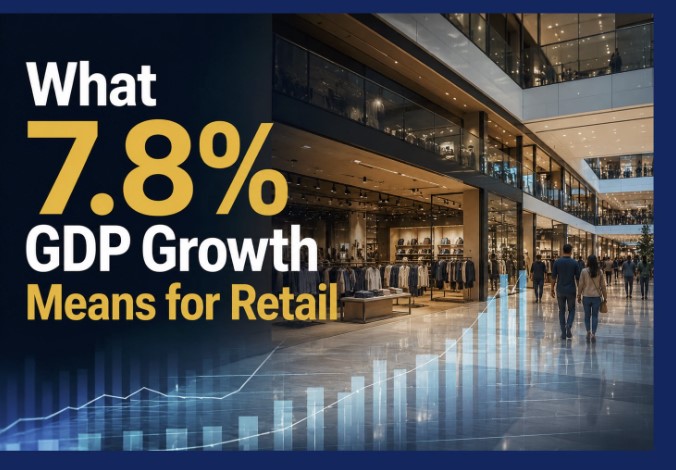
India's economy expanded 7.8% in Q1 FY27, but for the retail industry, an equally significant number is 7.1%—the growth in private consumption. Combined with an 11.9% rise in fixed investment and a 20% jump in retail real estate leasing during H1 2026, the numbers point to a consumption-investment cycle that is strengthening the case for organised retail expansion and carefully planned new shopping centres.
India has begun FY27 on a stronger-than-expected footing. Real GDP grew 7.8% in the April-June quarter, ahead of market expectations and significantly higher than the 6.9% growth in Q1 FY26. Nominal GDP expanded 10.3%, while Gross Value Added (GVA) grew 8.2%, reflecting broad-based momentum across manufacturing, services and domestic demand.
For India's retail ecosystem, however, the most consequential takeaway lies beneath the headline GDP number. Private Final Consumption Expenditure (PFCE)—the broadest measure of household consumption—grew 7.1% in real terms. At the same time, Gross Fixed Capital Formation (GFCF) expanded 11.9%, creating an unusually powerful combination: consumers are continuing to spend while investment is building capacity for the future.
The ₹88.27 Lakh-Crore Economy and the 7.1% Consumption Signal
India's nominal GDP reached approximately ₹88.27 lakh crore in Q1 FY27, but retail's interest in the GDP data goes beyond the size of the economy. Consumption remains the most direct transmission channel between macroeconomic growth and retail demand, influencing everything from store expansion and category growth to leasing activity and investment in physical retail infrastructure.
A 7.1% increase in real private consumption means households continued to increase actual consumption volumes despite global uncertainty and emerging inflationary pressures. This matters particularly for organised retail, which is simultaneously navigating premiumisation at one end of the market and intense value consciousness at the other.
The Indian consumer, therefore, is not a homogeneous growth story. But the aggregate numbers suggest that the consumption base itself remains resilient enough to support continued expansion across fashion, food and beverage, beauty, jewellery, electronics, grocery, entertainment and other discretionary categories.
Consumption Is the Floor; Investment Is Building the Next Growth Cycle
The more interesting aspect of the Q1 numbers is the simultaneous strength of consumption and investment. Private consumption grew 7.1%, while GFCF accelerated significantly faster at 11.9%. For retail, these two numbers represent different parts of the same growth cycle.
Consumption creates current demand. Investment builds tomorrow's capacity to serve that demand.
Across India's retail ecosystem, this investment is visible in new stores, distribution centres, supply chains, technology, omnichannel infrastructure and increasingly, high-quality retail real estate. Retailers and brands are expanding their physical footprints even as digital commerce continues to grow, underlining the fact that online and offline retail are increasingly complementary rather than competing growth channels.
This is also where the GDP story begins to intersect with India's shopping-centre development story.
A growing consumer economy does not automatically justify more malls. India has seen enough examples of poorly conceived retail developments to establish that consumption growth alone cannot compensate for weak location, inadequate catchment analysis or poor tenant mix.
But sustained consumption growth does create the economic foundation upon which organised retail infrastructure can expand.
From Consumer Spending to Store Expansion to Shopping Centres
The progression is relatively straightforward: growing consumption encourages brands and retailers to enter new markets and add stores; store expansion increases demand for quality retail space; sustained occupier demand then improves the economics of developing new shopping centres.
There is already measurable evidence of this chain at work.
India's retail real estate market recorded approximately 3.9 million sq. ft. of leasing during H1 2026, a 20% year-on-year increase. Q2 alone contributed around 2 million sq. ft., demonstrating continued occupier confidence despite geopolitical and supply-chain uncertainties.
The composition of this demand is equally revealing. Fashion and apparel accounted for approximately 40% of leasing, followed by F&B at around 14% and entertainment at 9%. Domestic retailers contributed more than 70% of total space take-up, while D2C brands increased their share to 28%, reflecting the continuing migration of digitally native brands into physical retail.
Why the Next Shopping-Centre Opportunity Is More Selective
The consumption story does not mean India needs shopping centres everywhere. Rather, it strengthens the opportunity for better targeted, differentiated and economically sustainable retail destinations.
The next phase of shopping-centre development will increasingly depend on identifying consumption clusters where population density, disposable income, retailer demand, accessibility and the absence—or inadequacy—of organised retail infrastructure converge.
This opens opportunities across emerging suburban corridors, rapidly urbanising peripheral districts and selected Tier II and III cities. However, the development thesis will need to be sharper than the old model of simply acquiring land and filling a building with stores.
Today's consumer expects more from a shopping destination. Fashion and shopping remain important anchors, but F&B, entertainment, wellness, beauty, community experiences and digital engagement are becoming increasingly integral to the shopping-centre proposition.
The H1 leasing numbers reflect this evolution. With F&B and entertainment together accounting for more than one-fifth of space take-up, the demand is increasingly for destinations rather than conventional shopping boxes.
The Supply-Demand Equation Is Tilting Towards Quality
An important feature of India's current retail real estate market is that demand has been growing faster than the availability of quality new supply in several markets.
Only around 0.9 million sq. ft. of new retail supply was added during H1 2026, even as leasing reached approximately 3.9 million sq. ft. This does not mean India faces a blanket shortage of retail space—there is considerable variation in quality and performance across markets—but it does highlight the premium being placed on well-located, institutionally developed and professionally managed assets.
The implication for developers is significant. The opportunity is not necessarily to build more shopping centres. It is to build shopping centres that can attract the expanding universe of retailers competing for India's growing consumer wallet—and remain relevant as the nature of consumption changes.
The distinction between retail space and retail destination will become increasingly important.
A Wider Consumer Economy Is Supporting a Wider Retail Ecosystem
The GDP data also offers encouraging signals from the supply side. Manufacturing grew 9.2%, while the broader trade, hotels, transport, communication and related services ecosystem expanded 8.5%.
Retail benefits from this wider economic activity. Rising incomes and employment support consumption, while growth in travel, hospitality, entertainment and services expands the number of occasions on which consumers spend.
This is particularly relevant for shopping centres, which are increasingly competing not just with other malls or high streets, but for a share of the consumer's overall discretionary time and wallet.
The successful shopping centre of the next decade will therefore be less dependent on transactional shopping alone. Its economics will increasingly rest on its ability to aggregate multiple consumption occasions—from fashion purchases and restaurant visits to cinema, children's entertainment, wellness and social experiences.
That transformation is already visible in retailer leasing patterns.
The Big Retail Takeaway: 7.8% Is the Headline, 7.1% Is the Signal
India's 7.8% GDP growth is an important statement of economic resilience, particularly against a backdrop of geopolitical uncertainty and elevated energy risks. But for retailers, retail developers and shopping-centre owners, the more actionable number is 7.1% private consumption growth.
It suggests that the Indian consumer remains a powerful source of domestic economic momentum.
When combined with 11.9% investment growth and a 20% increase in retail leasing during H1 2026, the numbers begin to reveal a broader cycle: consumption is supporting retail expansion, retail expansion is driving demand for quality physical space, and that demand is strengthening the long-term investment case for the next generation of shopping centres.
The caveat is equally important. Consumption growth is not a licence to build indiscriminately. The next winners will be projects developed around real consumption density, strong catchments, differentiated experiences and retailer economics.
India's growth story is increasingly a consumption story. And as that consumption base expands, the opportunity is moving beyond selling more products. It is also about building the places where India's next generation of consumers will choose to shop, eat, spend time and experience brands.


comments


Other categories
Recent Comments